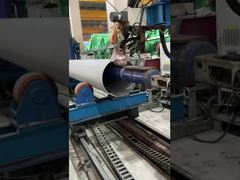
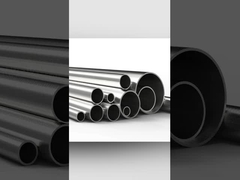
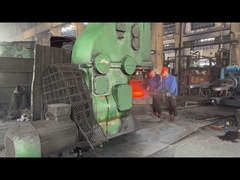
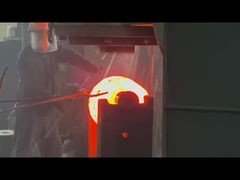
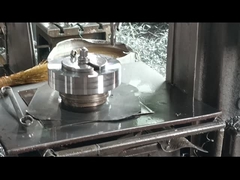
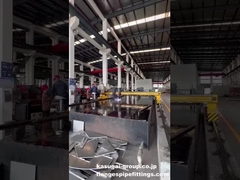
Brief: Get a guided demo that shows common workflows and troubleshooting tips. This video provides an on-site inspection walkthrough for ASTM A249, A269, and A312 welded stainless steel tubing. You'll see how these critical standards ensure quality, dimensional accuracy, and performance in industrial applications, including demonstrations of surface finishes like BA and non-destructive testing procedures.
Related Product Features:
Conforms to ASTM A249, A269, and A312 standards for welded austenitic stainless steel tubing and pipe.
Manufactured from corrosion-resistant grades including 304/304L, 316/316L, 321, 347, and duplex steels.
Features excellent strength, durability, formability, and weldability for various service conditions.
Available with BA (Bright Annealed) finish for superior surface cleanliness and dimensional accuracy.
Suitable for high-temperature environments and general corrosion-resisting applications.
Undergoes stringent non-destructive testing including eddy current, hydrostatic, and flaring tests.
Available in both welded and seamless forms with precise dimensional tolerances.
Used in boilers, heat exchangers, condensers, instrumentation, and chemical plant piping systems.
FAQs:
What is the main difference between ASTM A249 and ASTM A269?
ASTM A249 specifically covers welded austenitic stainless steel tubes for boilers, superheaters, heat exchangers, and condensers, while ASTM A269 covers both seamless and welded tubes for general corrosion-resisting and temperature service, and is the common standard for BA tubes.
Can ASTM A312 tubes be used for high-pressure applications?
Yes, ASTM A312 tubes are designed for general corrosion-resisting and high-temperature service and can be used in various pressure applications, though specific high-pressure roles may require standards like A209 or A249 depending on the applicable pressure vessel code.
What does 'BA' mean in the context of stainless steel tubing?
BA stands for Bright Annealing, a process where the tube is annealed in a controlled atmosphere to prevent oxidation, resulting in a smooth, bright, and clean surface ideal for high-purity applications without requiring mechanical polishing.
What are the common material grades under these specifications?
The most common grades across A249, A269, and A312 are 304/304L and 316/316L, with other options including 321/321H, 347/347H, 310S, and duplex steels based on specific corrosion and temperature requirements.